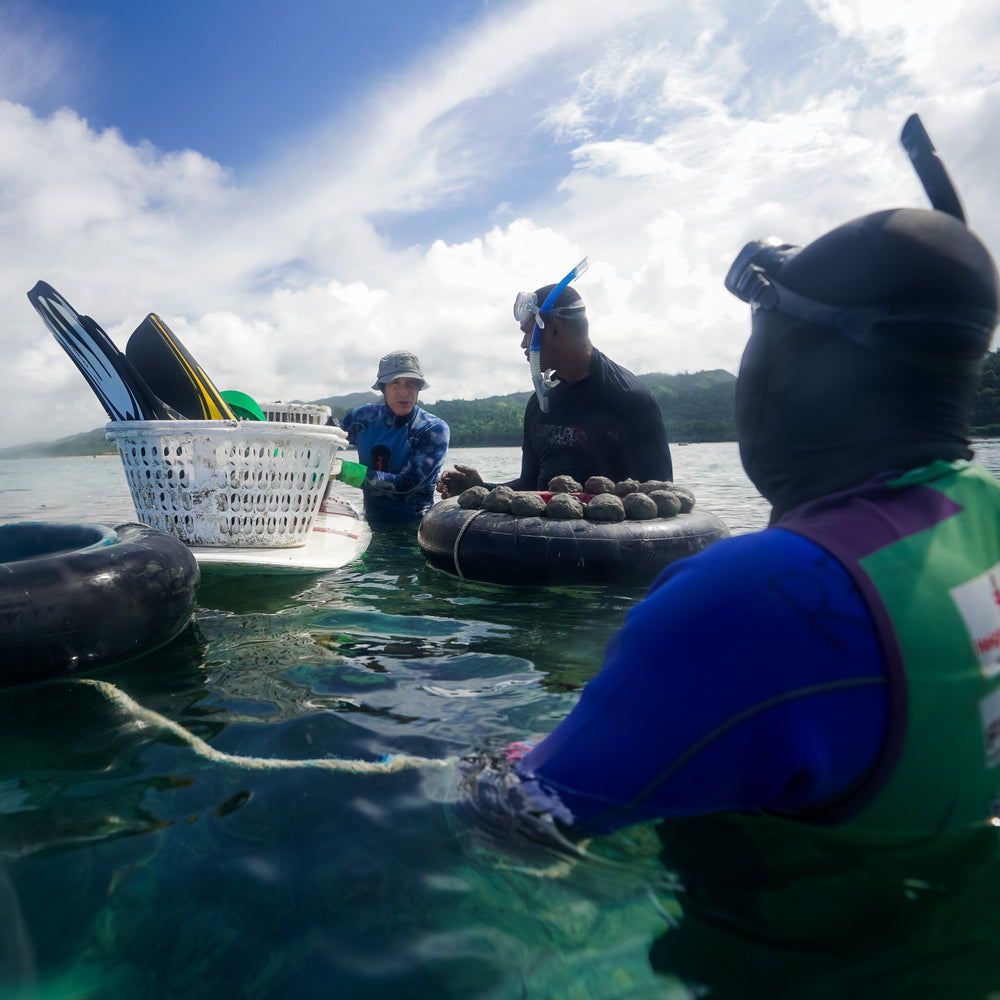
Bring Fiji’s coral reefs back to life—home to 200+ coral species and some of the most vibrant marine ecosystems in the South Pacific. Your donation revives reefs and supports the communities protecting them for future generations.
6,000Coral fragments planted
9,000Coral colonies restocked in rope nurseries
10,000Corals propagated annually
4Active reef restoration sites
How it works
Select. Grow. Outplant.
Rather than replanting collapsed reefs, the Seatrees works with Reef Explorer to strengthen healthy reef zones with coral that has already survived past heatwaves.
1.Select
Coral fragments are collected from colonies that have already survived past heat stress events. These are the toughest of the bunch — chosen specifically for their ability to withstand warming waters.
2.Grow
These coral fragments are secured to rope nursery lines suspended in the water column, where they grow for 6–12 months in ideal, predator-free conditions.
3.Outplant
Once large enough, the corals are planted directly into healthy reef zones. Depending on the site, they’re attached to hard reef substrate or vertical structures using clips or marine epoxy.
Selection
Rope nursery
Outplanting
See the restoration in action
Project partner
Reef Explorer
Reef Explorer is a leading coral restoration organization in Fiji, collaborating with local communities since 2006. Their work is grounded in science and cultural partnership, advancing climate-resilient reef ecosystems and local marine management. Reef Explorer supports research, coral taxonomy, and adaptation-focused coral breeding programs across Fiji.
Their restoration approach is not about replanting dead reefs, but enhancing thriving ones by creating breeding populations of thermally resilient corals. Their work is backed by institutions like Mission Blue, NatGeo, and the Fiji government.
Seatrees evaluates every project against the 17 UN Sustainable Development Goals. The Viti Levu coral project supports 3 of them.
Goal 1No PovertyBy providing fair wages and skills training in coral restoration, the project creates meaningful jobs for community members — helping support local livelihoods and boost food security through healthier, fish-rich reefs.Explore all 17 UN Goals →
Goal 4Quality EducationReef Explorer regularly hosts educational workshops and hands-on training for local youth and elders, deepening their knowledge of reef ecosystems, marine science, and sustainable resource management.Explore all 17 UN Goals →
Goal 14Life Below WaterThis project actively protects and restores marine biodiversity by planting thermally tolerant coral species, removing invasive predators like Crown-of-Thorns Starfish, and safeguarding fish populations through community-managed marine protected areas. These efforts help strengthen reef resilience in the face of climate change.Explore all 17 UN Goals →
From the field
Life on the reef
Protecting the reef for the long term
Ongoing protection and predator removalThe team continuously removes Crown-of-Thorns Starfish (COTS), a major predator responsible for large-scale coral loss across the Pacific.
Monitoring through photogrammetryBiannual 3D reef surveys using smartphone cameras allow scientists and local teams to track reef growth and health over time. This method produces high-resolution 3D visualizations of the reef, showing where coral cover is increasing and how biodiversity is returning.Learn More about Photogrammetry →
Community training and co-managementLocal villagers and youth are trained in coral restoration techniques and monitoring methods. Traditional and scientific knowledge are merged to strengthen village-based reef stewardship.